
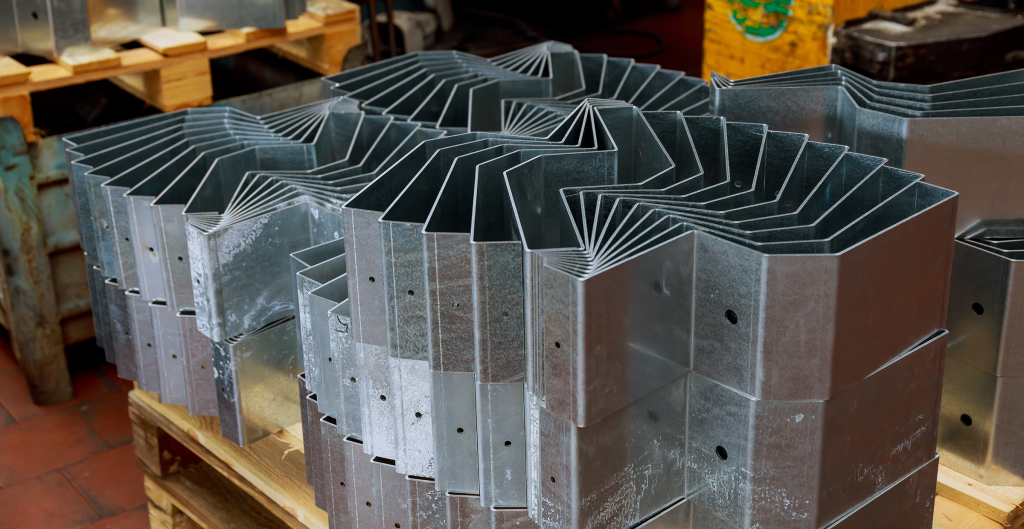
Deep drawing is a method of stamping metal. It is an effective and versatile way of turning metal sheets into various complex shapes. At Degele Manufacturing in New Baltimore, MI, we utilize this technology to produce components that are high in quality, precise, and customized for your specific requirements. Gaining knowledge of the deep drawing process can make you realize the skill and creativity behind every piece we manufacture. We will now descend into deep drawing’s domain and find out how it can be advantageous to your production projects.
What is Deep Drawing?
Deep drawing is the process that requires the metal sheet to be stretched around a plug, which is often called a blank. The rings will keep the edges of the metal blank in position, while a plug will be pulled into a top die cavity in order to form the intended shape. This technique can produce a variety of shapes, such as cups, pans, cylinders, domes, and even irregular merchandise. The adaptability of deep drawing is a company that modern manufacturing cannot do without.
The total drawing load in deep drawing consists of the ideal forming load and additional components to compensate for friction and bending forces. As the metal is drawn, tensile forces act on the part wall, leading to wall thinning. This thinning is most pronounced at the point where the part wall loses contact with the punch, typically at the punch radius. The thinnest part of the wall determines the maximum stress that can be transferred to the deformation zone. Due to material volume constancy, the flange thickens, resulting in contact at the outer boundary rather than across the entire surface.
One key indicator of material formability in deep drawing is the limiting drawing ratio (LDR). This ratio is defined as the maximum blank diameter that can be safely drawn into a cup without a flange, divided by the punch diameter. Determining the LDR for complex components can be challenging, so we often inspect critical areas for approximations. During severe deep drawing, the material work hardens, and it may be necessary to anneal the parts to restore their original elasticity.
Deep drawing is often combined with other forming techniques within the press. These additional techniques are beading, bottom piercing, bulging, coining, curling, extruding, ironing, necking, notching, rib forming, side piercing, stamping, threading, and trimming. They all serve to enhance the end product’s specifications.
Practical Applications of Deep Drawing
Deep drawing is a prominent technique in the manufacturing of auto bodies and other parts of the metal structure for the aircraft industry, kitchenware, and refrigerator items. Progressive dies typically form thick parts in one press or by working the press line. The process is made even more precise with the ability to govern the mass production, and thus it is the only method suitable for companies that need assurance and changeability.
We at Degele Manufacturing extensively use deep drawing for various components being supplied to clients. Our facilities, equipped with modern technology and a skilled team, can produce both volumes of small parts and complex assemblies, as per your requirements. We can provide stamping of small and large-scale parts, with different press sizes that vary from 40 to 400 tons, depending on the customer’s application needs. Our process-oriented manufacturing capabilities will help you save time and cost while ensuring that your projects are done in a manner that meets the highest standards ever.
We produce between 2,500 and millions of tiny parts per year and 500 to 100,000 complex assemblies annually, as our production capabilities. Prototype support is also part of our offerings and includes CAD reading of the most popular formats, design for manufacturability, and short-run production. Our secondary operations comprise services like welding, brazing, tumbling, fixtures, wire EDM, CNC milling and turning, and partnership for waterjet, laser, heat treat, and finishing services.
Advanced Techniques and Innovations
Deep drawing has evolved over the years, with the development of both conventional and unconventional deep drawing processes. Unconventional processes aim to extend the formability limits of the material. Some of these processes include hydromechanical deep drawing, the Hydroform process, the Aquadraw process, the Guerin process, the Marform process, and hydraulic deep drawing.
The Marform process, for example, operates using the principle of rubber pad forming techniques. The method permits making parts with deep recesses and either vertical or sloping walls. The method of Marforming applies a rubber pad as one tool half and a solid tool half as the other. The setting permits deep drawings with a minimum of wrinkles, making it suitable for intricate designs. The process uses single-action presses with die cushions and material holders, which guarantee accuracy and uniformity.
Why Degele Manufacturing?
Partnering with Degele Manufacturing brings you our many years of experience and assurance of quality as your advantage. We have been in the market since 1970, and our people are committed to meeting or surpassing your expectations, irrespective of the program we take up. Our separate areas for tooling, machining, manufacturing, inspection, assembly, and maintenance not only enable us to operate with less time and resources but also give you the best value.
Our approachable and experienced staff are ready to assist you through the whole process. Be it a prototype, short-run production, or mass manufacturing, we have the skills and know-how to do it. The understanding of the uniqueness of each project leads to close cooperation with our customers in order to accommodate their specific needs.
So, if you want a trustworthy partner for your metal stamping requirements, consider no other than our expertise here at Degele Manufacturing in New Baltimore, MI. Call us at (586) 949-3550 to talk about your project and to find out how our deep drawing skills can positively affect your manufacturing process. Allow us to help you realize your concepts through precision, efficiency, and superior quality.